Bambusa Bamboos
Common name – mullu mala
Usage – construction, Scaffolding, Ladders, Furniture, Pulp/Paper, Edible shoots, Leaf as fodder , Fencing
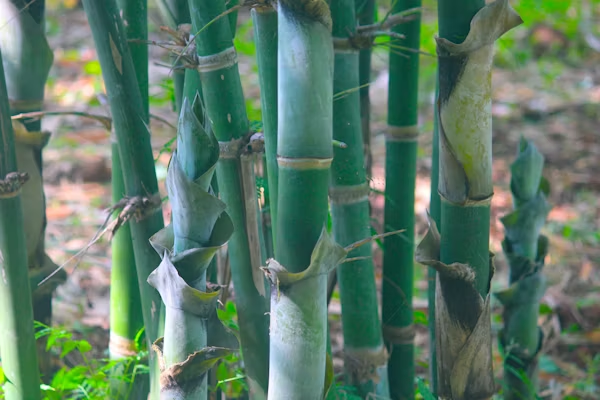
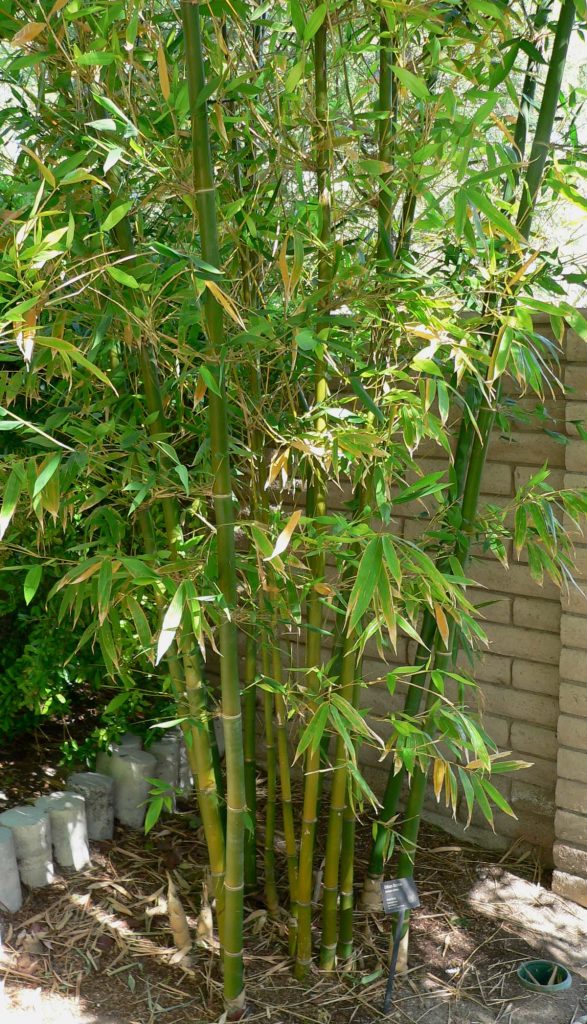
It is a tall, bright-green colored spiny bamboo species, which grows in thickets consisting of a large number of heavily branched, closely growing culms. It reaches a height of 10–35 m and grows naturally in the forests of the dry zones. It is very fast growing, lengthening up to 50 cm in the twelve night-time hours. Since most of the growth is at night, it probably practices Crassulacean Acid Metabolism or CAM. The record growth for this species is 90 cm in 24 hours at Kew Gardens near London in 1855. The culms are not straight, and are armed with stout, curved spines. They are bright green, becoming brownish green when drying, and the young shoots are deep purple. Branches spread out from the base. Aerial roots reach up to few nodes above. The internode length is 15–46 cm, and diameter is 3.0–20 cm, and the culm walls are 2.5–5.0 cm thick. Nodes are prominent and rootstock is stout. Culm sheaths are dark brown when mature, elongated, and cylindrical. Length of the sheath proper is 15–25 cm and 12–30 cm in width. Blade length is 4.0–12 cm. Auricles are not prominent. Upper surfaces of the sheath are covered with blackish-brown hairs. Lower surfaces of the sheath are not hairy. Sheaths fall early.
A plant of the humid tropical lowlands, where it can be found at elevation up to 1,000 metres. It grows best in areas where annual daytime temperatures are within the range 22 – 30°c, but can tolerate 8 – 36°c. It prefers a mean annual rainfall in the range 1,200 – 2,500mm, but tolerates 700 – 4,500mm.
Prefers a position in dappled shade, but also grows in full sun. Grows best in a fertile, moist soil. Prefers a pH in the range 4.5 – 6.5, tolerating 4 – 7. A fast-growing species, it forms a clump of stems up to about 5 metres tall within 7 years from seed and reaches full size after about 20 years, by which time there will be 25 – 50, perhaps even 100 culms Twelve-year-old clumps are regarded as mature. Bamboos have an interesting method of growth. Each plant produces a number of new stems annually – these stems grow to their maximum height in their first year of growth, subsequent growth in the stem being limited to the production of new side branches and leaves. In the case of some mature tropical species the new stem could be as much as 30 metres tall, with daily increases in height of 30cm or more during their peak growth time. This makes them some of the fastest-growing species in the world. Undisturbed clumps are almost impenetrable after some years because of the interlacing thorny branches.The plant flowers gregariously over a region at intervals of 16 – 45 years. A complete flowering period of the whole clump takes as long as 3 years. This flowering is followed by the profuse production of seed, after which the old clump dies.



Leave a Reply