Dendrocalamus longispathus
Common name – Long Sheath Bamboo
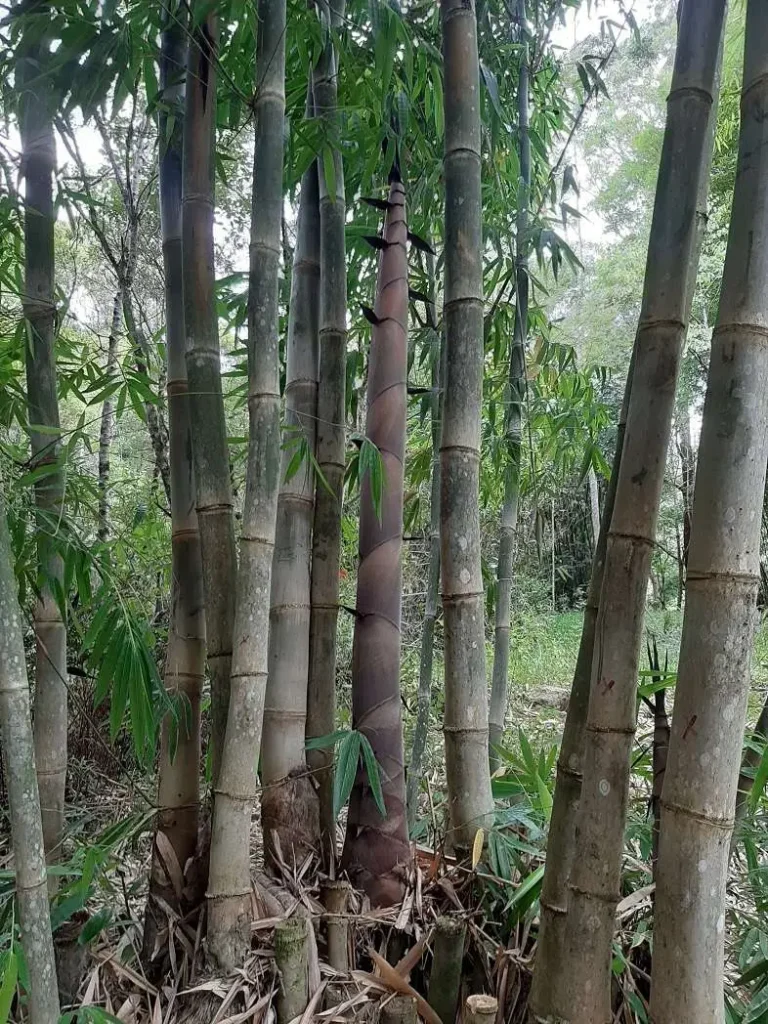
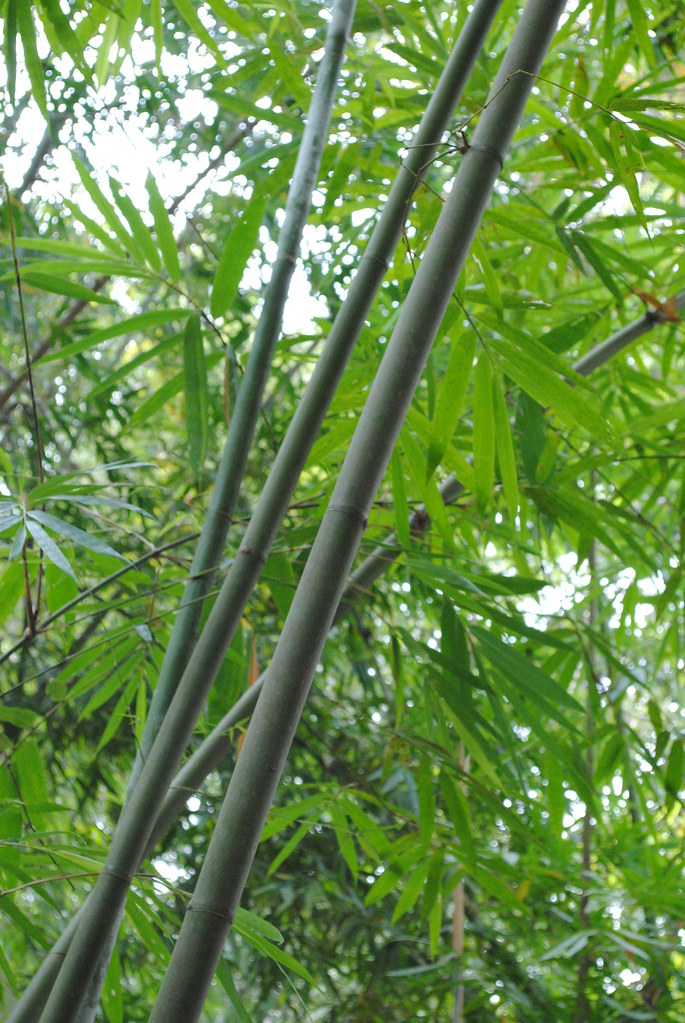
Culms are green with white blooms when young, which become greyish-green when dry. Young shoots are yellowish-green in color with shiny black hairs. Culm is straight. Branches spread out from the mid-culm to top. Aerial roots reach up to few nodes above the ground. Internode length is 25–50 cm, and diameter is 2.0–10 cm. Culm walls are 0.8–1.5 cm thick.Culm sheaths are green in young plants and turn brown when mature, and are elongated and cylindrical with narrow, lanceolate blades. The sheath proper is 10–20 cm in length and 13–20 cm wide. Blade length is 13–20 cm. Auricles are absent. Upper surfaces of the sheaths are covered with blackish-brown hairs. Lower surfaces of the sheaths are not hairy. Sheaths are persistent (do not fall).
Dendrocalamus longispathus, widely known as long-sheath bamboo, is a large, clumping evergreen species native to the moist hill forests of Bangladesh, Myanmar, and Thailand. It is highly valued across South Asia for its rapid growth and versatility in both industrial and local crafts.
A plant of the moist, lowland tropics and subtropics, where it is found at elevations up to 1,000 metres. It grows best in areas where annual daytime temperatures are within the range 20 – 27°c, but can tolerate 15 – 34°c. It prefers a mean annual rainfall in the range 1,800 – 3,600mm, but tolerates 1,200 – 4,500mm.
Grows best in full sun or light shade. Prefers a medium to heavy soil of at least moderate fertility. Prefers a pH in the range 5 – 6, tolerating 4.5 – 7.
A cutting cycle of every three years is recommended for this species.
Bamboos have an interesting method of growth. Each plant produces a number of new stems annually – these stems grow to their maximum height in their first year of growth, subsequent growth in the stem being limited to the production of new side branches and leaves. In the case of some mature tropical species the new stem could be as much as 30 metres tall, with daily increases in height of 30cm or more during their peak growth time. This makes them some of the fastest-growing species in the world.
Bamboos in general are usually monocarpic, living for many years before flowering, then flowering and seeding profusely for a period of 1 – 3 years before usually dying.


Leave a Reply