Bambusa Polymorpha
Common name – Burmese Bamboo
Usage – House construction, Woven matting, Baskets, Furniture, Handicrafts, Paper pulp and Board making, Edible shoots
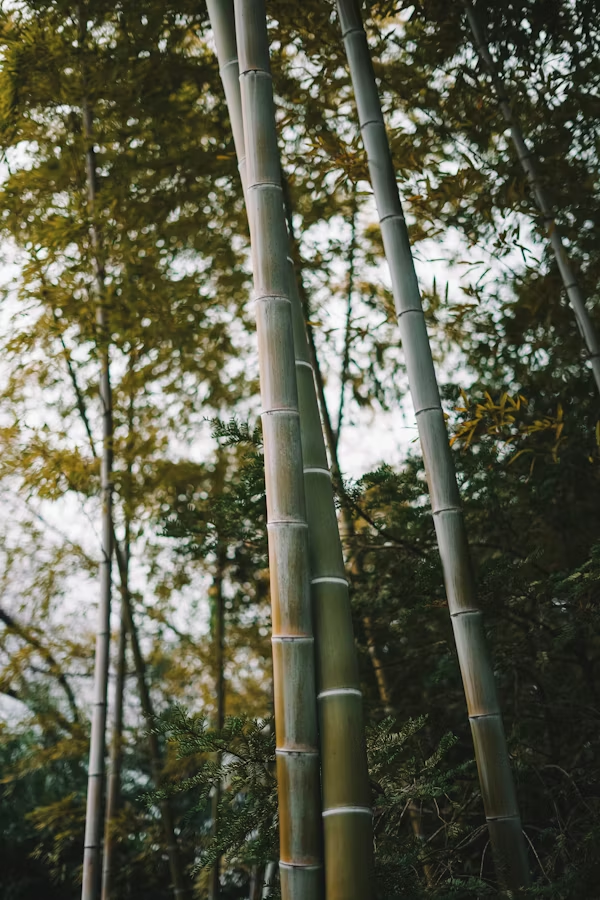
Bambusa polymorpha, commonly known as Burmese Bamboo or Jama Betua, is a large, dense, clumping bamboo species native to Southeast Asia, specifically Bangladesh, India, Myanmar, and Thailand. It is highly valued for its tall, straight culms (stems) which are used extensively in construction, pulp production, and handicrafts.
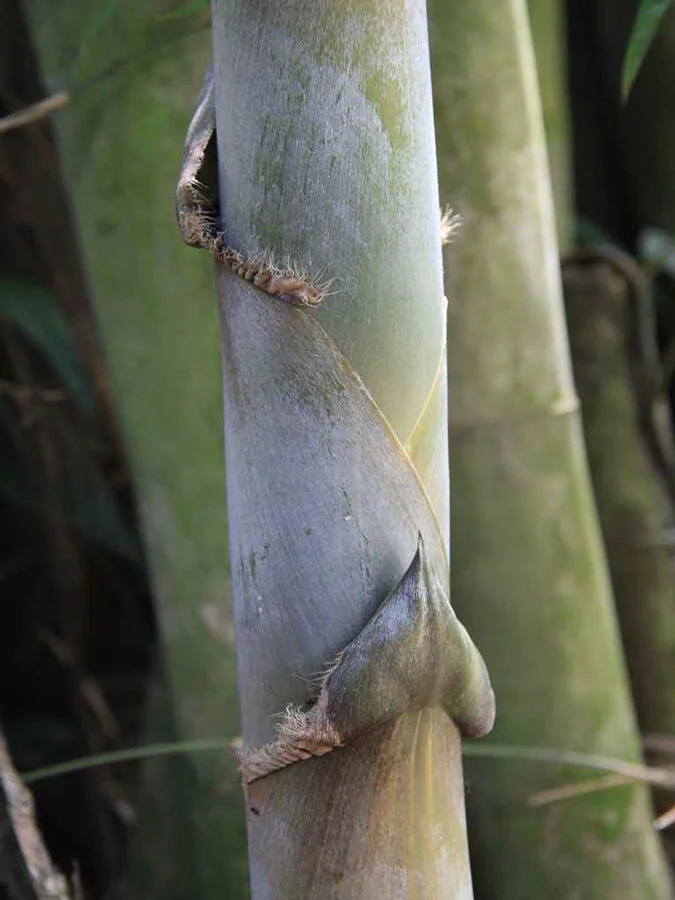
It is a tall, grayish green colored bamboo species, which grows in thickets consisting of a large number of heavily branched, closely growing culms. It reaches a height of 10–30 m. Culms are green, covered with whitish brown hair, and become brownish green when drying. Young shoots are greenish brown in color. Branching occurs from the mid-culm to the top. Aerial roots reach up to few nodes above ground. Young culm sheaths are greenish, which become yellowish brown when mature. Sheaths of growing shoots are golden yellow color, with cup-shaped blades. The sheath proper is 20–25 cm in length and 28–35 cm wide. Blade length is 5–10 cm. Auricles are equal, sickle-shaped, wavy, and curled. Upper surfaces of the sheaths are covered with brownish-black, closely pressed hairs. Lower surfaces of the sheaths are not hairy. Sheaths do not fall early, but blades fall. In India, it is used for walls, partitions, troughs, and mats. In Myanmar, it is used for making house frames, wattle-and-daub walls, partitions, concrete reinforcement, and ceilings. The young shoots are eaten, and taste very bitter. A plant of the tropics. It grows best in areas where annual daytime temperatures are within the range 22 – 28°c, but can tolerate 9 – 32°c[. It prefers a mean annual rainfall in the range 1,200 – 2,500mm, but tolerates 700 – 4,500mm.
Prefers a position in light shade, tolerating full sun. Grows best on a deep, fertile, well-drained, loam soils. Prefers a pH in the range 5 – 6, tolerating 4.5 – 6.5.
Bamboos have an interesting method of growth. Each plant produces a number of new stems annually – these stems grow to their maximum height in their first year of growth, subsequent growth in the stem being limited to the production of new side branches and leaves. In the case of some mature tropical species the new stem could be as much as 30 metres tall, with daily increases in height of 30cm or more during their peak growth time. This makes them some of the fastest-growing species in the world.
Bamboos in general are usually monocarpic, living for many years before flowering, then flowering and seeding profusely for a period of 1 – 3 years before usually dying. The life cycle of this species is estimated at 60 years. It normally flowers gregariously for about 2 – 3 years, after which the clump dies.
Natural regeneration is through seed, which is produced abundantly. A seedling needs more than 10 years to develop into a mature clump. In India, some 6-year-old clumps, developed from rhizome cuttings, contained on average 80 culms that were 11 metres tall and 17cm in diameter.
Harvesting of culms may start when clumps are more than 5 years old. Culms to be harvested should be older than 1.5 years; for construction purposes, 3 – 4-year-old culms are preferred. For a sustainable yield, at least 8 – 10 old culms should be left in the clump. To protect natural bamboo forests, proper harvesting regulations should be established.


Leave a Reply