Melocanna baccifera
Common name – Assam Mula
Usage – Edible shoots; extract from the culm can be used as a tonic in treating respiratory diseases
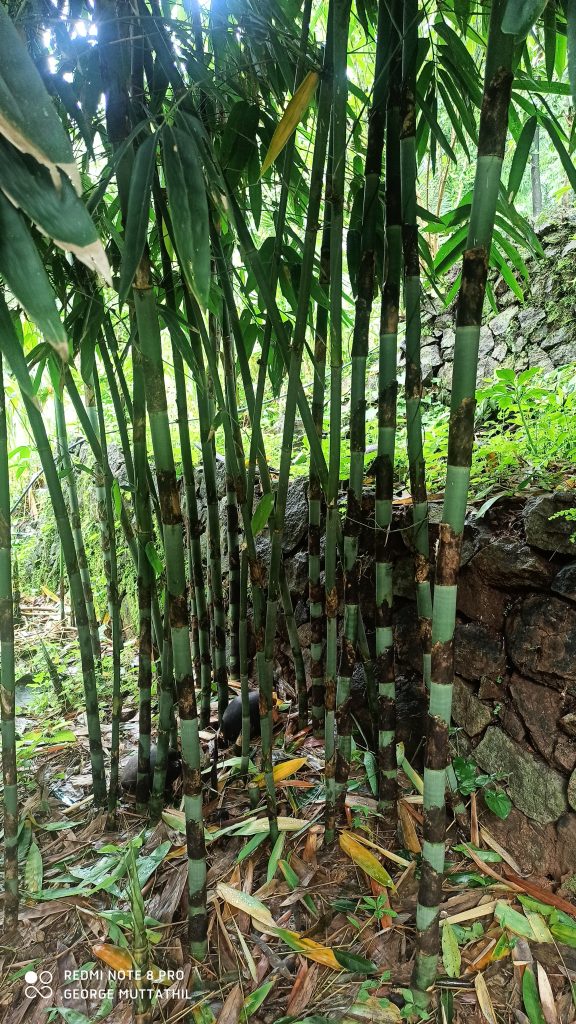
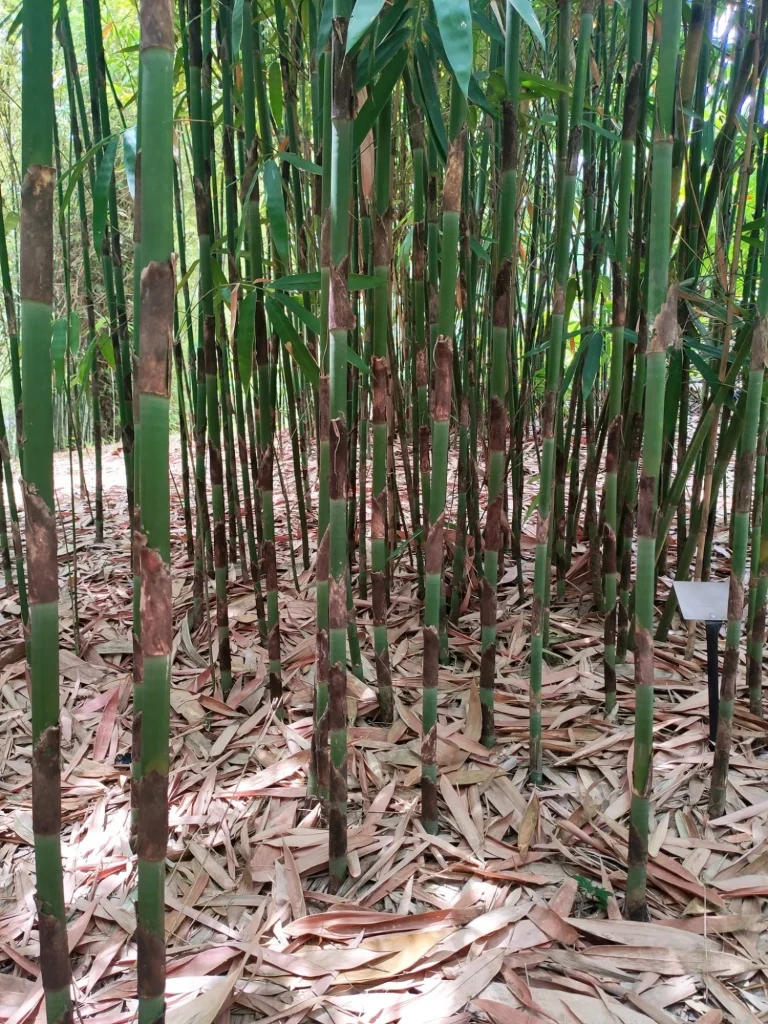
It is tall, small-culmed bamboo with greenish young culms and straw-coloured old culms. It grows in clumps composed of many well-spaced culms. It has a dense appearance due to its branching habit. The culms are greenish when young, but becomes straw-coloured when mature or brownish green when drying. Young culms are covered with stiff, silver hairs. A white bloom occurs just below the nodes. Young shoots are yellowish brown. The culms are straight; branching occurs from the base, and branches are many, short, loose, and open. The internode length is 25–50 cm, and diameter is 1.5–15 cm. The culm walls are thin, and the nodes are prominent. The culm sheaths are greenish in young plants, turning brown when mature. The sheath proper is 7–15 cm long and 2.5–15 cm wide. The blade length is 10–30 cm. The auricles are equal. The upper surface of the sheath is covered with white hairs. The lower surface of the sheath is not hairy. The sheaths do not fall off, only the blades fall off. Melocanna baccifera flowers almost fully synchronically every 48 years. verified bloomings having occurred in 1863, 1911, 1959, and 2007 with a precision exceeded only by Strobilanthes kunthiana This flowering results in the phenomenon known as Mautam; the population of black rats Rattus rattus burgeons owing to the plentiful food supply provided by the bamboo fruit (up to 80 tonnes per hectare[2]), and once this is exhausted, famine follows as the rats move on to consume local crops, notably in the Northeast Indian state of Mizoram. The Jawaharlal Nehru Tropical Botanic Garden and Research Institute (JNTBGRI) Thiruvananthapuram conducted a study for 13 years between 2009 and 2022 on the flowering of Melocanna baccifera and its relation to the occurrence of ‘rat floods’. Another peculiarity of M. baccifera is that, like Rhizophora species, its seeds can germinate while still attached to the mother plant, so that they drop to the ground as plantlets. Researchers have reported the highest ever fruit production of 456.67 kg in the bamboo clump. Melocanna baccifera is an evergreen bamboo with an elongated rhizome that produces single culms arising at a distance of about 60 cm apart and reaching a height of 10 – 20 metres. The thin-walled culms have a diameter of 50 – 90mm, with internodes 30 – 60cm long. It is an aggressive bamboo, easily occupying large open areas, due to its vigorous long rhizomes and, when fruiting, due to its easily germinating fruits .One of the most useful bamboos within its native range, especially in Bangladesh, it provides edible shoots, medicine and culms that have a wide range of uses. Usually gathered from the wild, it is occasionally cultivated for these uses.



Leave a Reply