Bambusa nutans
Common name – Nutans
Usages – Basktes,Fences,Roofs and Roof tiles,Paper,Handicrafts
Bambusa nutans is a tropical, clumping bamboo species native to India, Bangladesh, Thailand, and Myanmar, often known as Burmese timber bamboo. It grows 6-15 meters tall, featuring thick-walled green culms used for construction and paper pulp. This evergreen bamboo grows at altitudes up to 1500 meters.
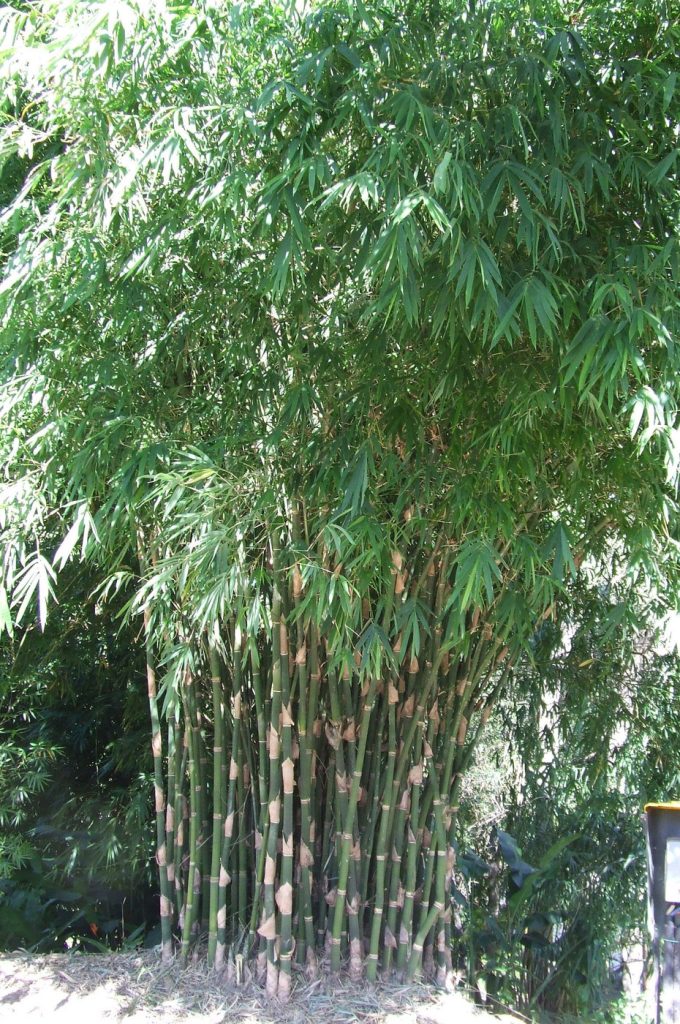
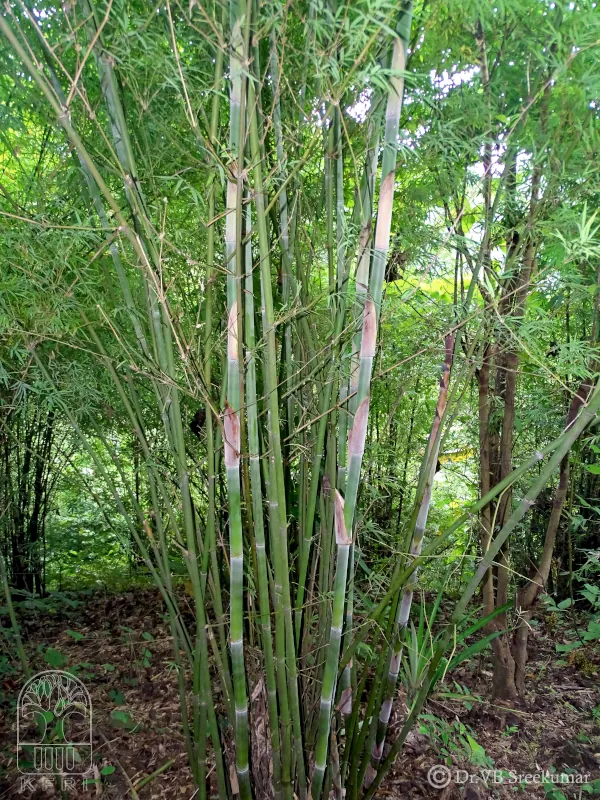
Bambusa nutans is an evergreen, clump-forming bamboo that grows to a height of 6–15 meters, with some reports indicating up to 23 meters. The culms (stems) are erect, dense, and thick-walled, measuring 4–10 cm in diameter with internode lengths of 25–45 cm. Young culm sheaths are green, turning pale yellow or brown with age, with the adaxial surface smooth and abaxial surface slightly hairy, featuring ciliate margins. Leaves are narrow lanceolate, measuring 15–30 cm long and 2–4 cm wide, with pointed tips. The inflorescence is generally a large, loose panicle with drooping branches, and flowering occurs rarely in gregarious cycles every 30–50 years. Seeds are often non-viable, so propagation is mainly through clump division, offsets, culm cuttings, or tissue culture.
Bambusa nutans naturally occurs in tropical and subtropical regions of Southeast Asia, including India (Assam, Orissa, Arunachal Pradesh, West Bengal, Bihar, Himachal Pradesh, Madhya Pradesh, Tripura, Sikkim, Uttar Pradesh, Uttarakhand), Bangladesh, Myanmar, Thailand, and parts of China
. It typically grows at altitudes ranging from 600 to 1,600 meters and favors moist, well-drained fertile soils but can adapt to a variety of soil types. It thrives in both full sun and partial shade, tolerating temperatures between 9–32°C and annual rainfall from 700–4,500 mm.
Bambusa nutans, or nodding bamboo, is a tall (10–22 meters), clump-forming, tropical bamboo native to the Himalayas and Southeast Asia, widely cultivated for construction, furniture, and paper pulp. It is known for its thick-walled, erect, green culms (4–10 cm diameter) and is highly valued as an ornamental and commercial resource. A plant of the tropics, where it is found at elevations up to 1,600 metres. It grows best in areas where annual daytime temperatures are within the range 22 – 28°c, but can tolerate 9 – 32°c. It prefers a mean annual rainfall in the range 2,300 – 3,000mm, but tolerates 700 – 4,500mm.
Succeeds in full sun and in dappled shade. Grows best in a fertile, heavy soil. Prefers a pH in the range 6 – 7, tolerating 5.5 – 7.5. Bamboos have an interesting method of growth. Each plant produces a number of new stems annually – these stems grow to their maximum height in their first year of growth, subsequent growth in the stem being limited to the production of new side branches and leaves. In the case of some mature tropical species the new stem could be as much as 30 metres tall, with daily increases in height of 30cm or more during their peak growth time. This makes them some of the fastest-growing species in the world. Bamboos in general are usually monocarpic, living for many years before flowering, then flowering and seeding profusely for a period of 1 – 3 years before usually dying.



Leave a Reply