Bambusa Tulda
common name – Bengal Mula
Usage – Agarbatti sticks, Lumber, Paper, Handicrafts, Edible shoots, Construction
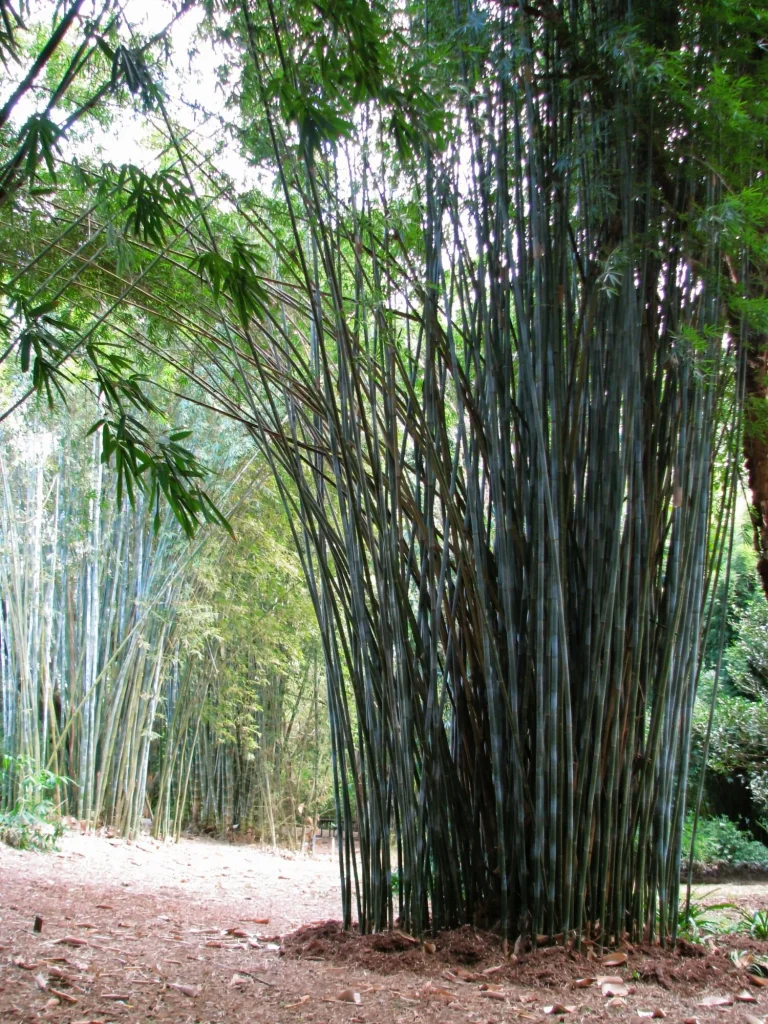
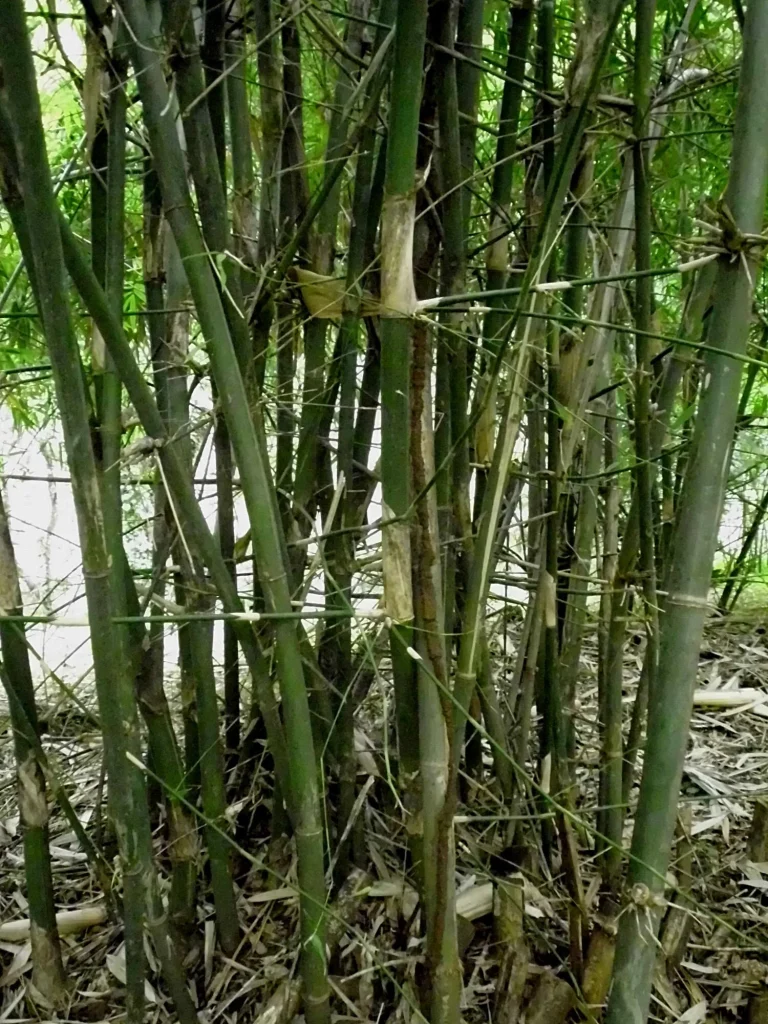
It is a tall, dull green colored bamboo species with greyish green when mature. It is composed of few closely growing culms. It reaches a height of 6–23 m. Young culms are green, which become greyish green when mature and brown when drying. Young shoots are yellowish green in color with a powdery top. Culms are covered with white blooms. A band of white hairs occurs above the nodes. Branching occurs from the base to top. Aerial roots reach up to few nodes above. Internode length is 30–60 cm, and diameter is 0.8–1.2 cm. Culm walls are very thick. Nodes are prominent. Culm sheaths are triangular with a conical blade, and straw-colored. The sheath proper is asymmetrical and 15–32 cm in length and 25–34 cm wide. Blade length is 5–10 cm. Auricles are unequal where the large one is rounded and situated on the side of the blade. The upper surface of the sheath is covered with blackish-brown hairs. The lower surface of the sheath is not hairy. Sheaths fall off early.
Bambusa tulda is a plant of the moist, lowland tropics, where it is found at elevations up to 1,500 metres. It grows best in areas where annual daytime temperatures are within the range 22 – 28°c, but can tolerate 9 – 32°c. It prefers a mean annual rainfall in the range 1,200 – 2,500mm, but tolerates 700 – 4,500mm.
Prefers a position in dappled shade, also succeeding in full sun. Grows best in fertile, medium to heavy soils. Prefers a pH in the range 5 – 6, tolerating 4.5 – 6.5.
Bamboos have an interesting method of growth. Each plant produces a number of new stems annually – these stems grow to their maximum height in their first year of growth, subsequent growth in the stem being limited to the production of new side branches and leaves. In the case of some mature tropical species the new stem could be as much as 30 metres tall, with daily increases in height of 30cm or more during their peak growth time. This makes them some of the fastest-growing species in the world.
About one month after germination a seedling produces its first stem and at this stage the rhizome also starts to develop. After 9 months 4 – 5 young culms have been formed.
Shoot growth starts at the beginning of the rainy season and it takes approximately 1 month to emerge above the ground. Height increase of the shoots may attain as much as 70 cm per day. Culms complete their growth within 2 – 3 months after their emergence as shoots, and their diameter and height do not increase as they become older.
Young shoots to be used as a vegetable should preferably be harvested while they are still underground. In plantations, selective felling of older culms may start 5 – 7 years after planting. Normally 3 – 4-year-old culms are harvested, retaining at least 3 – 6 evenly spaced culms per clump. A 4-year felling cycle is often adopted.
Traditionally, the harvested canes are submerged for 10 – 20 days in running water to improve resistance to powder-post beetles. Subsequently the culms are air dried for 1.5 – 3.5 months. The culms suffer considerably from cracking and collapse. Cracks often extend along the entire length of the internodes and the culm collapses at these cracks. To improve their durability, culms can be treated with solutions of sodium carbonate, calcium hydroxide or copper sulphate. The annual yield of dry culms is about 3 tonnes/ha in India.
Bamboos in general are usually monocarpic, living for many years before flowering, then flowering and seeding profusely for a period of 1 – 3 years before usually dying. Bengal bamboo normally flowers gregariously for a period of 2 years in a cycle of 25 – 40 years, and produces viable seed. However, it also often flowers sporadically or in small groups, without an obvious cycle.
In Bangladesh several forms are distinguished: ‘tulda bans’ is the normal form; ‘jowa bans’ is a large form with longer and thicker culms, mainly used for scaffolding and construction; and ‘basini bans’ is a form with a larger cavity in the culms and is mainly used for basketry

Leave a Reply