Dendrocalamus strictus
Common name – kallan mula
Usage – Construction and Furniture
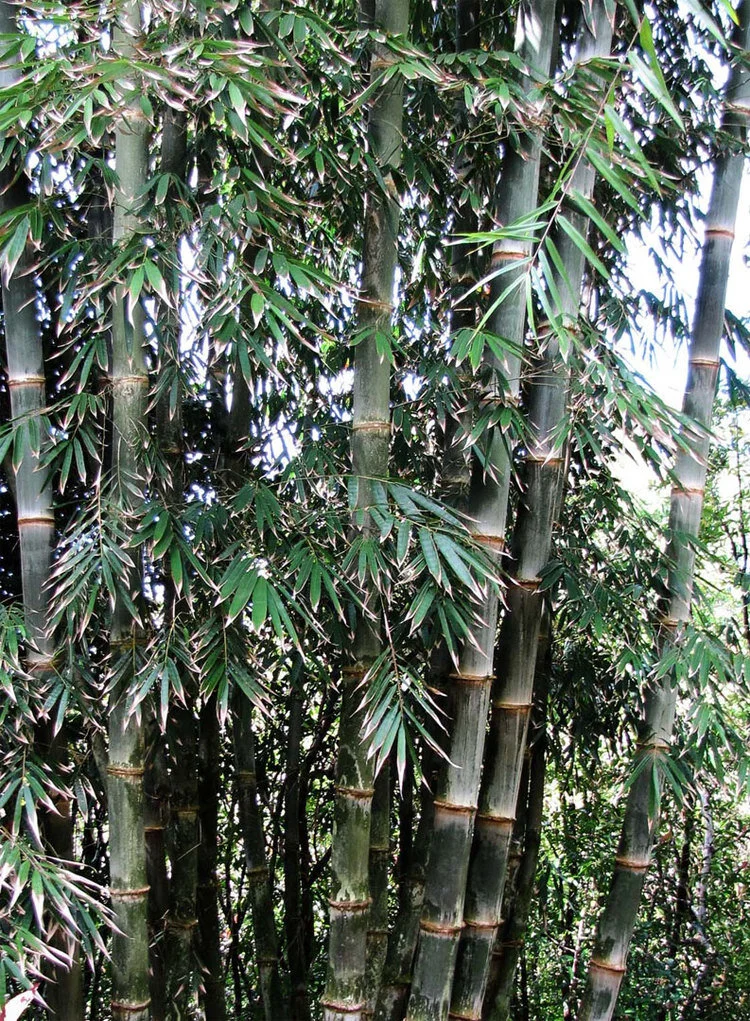
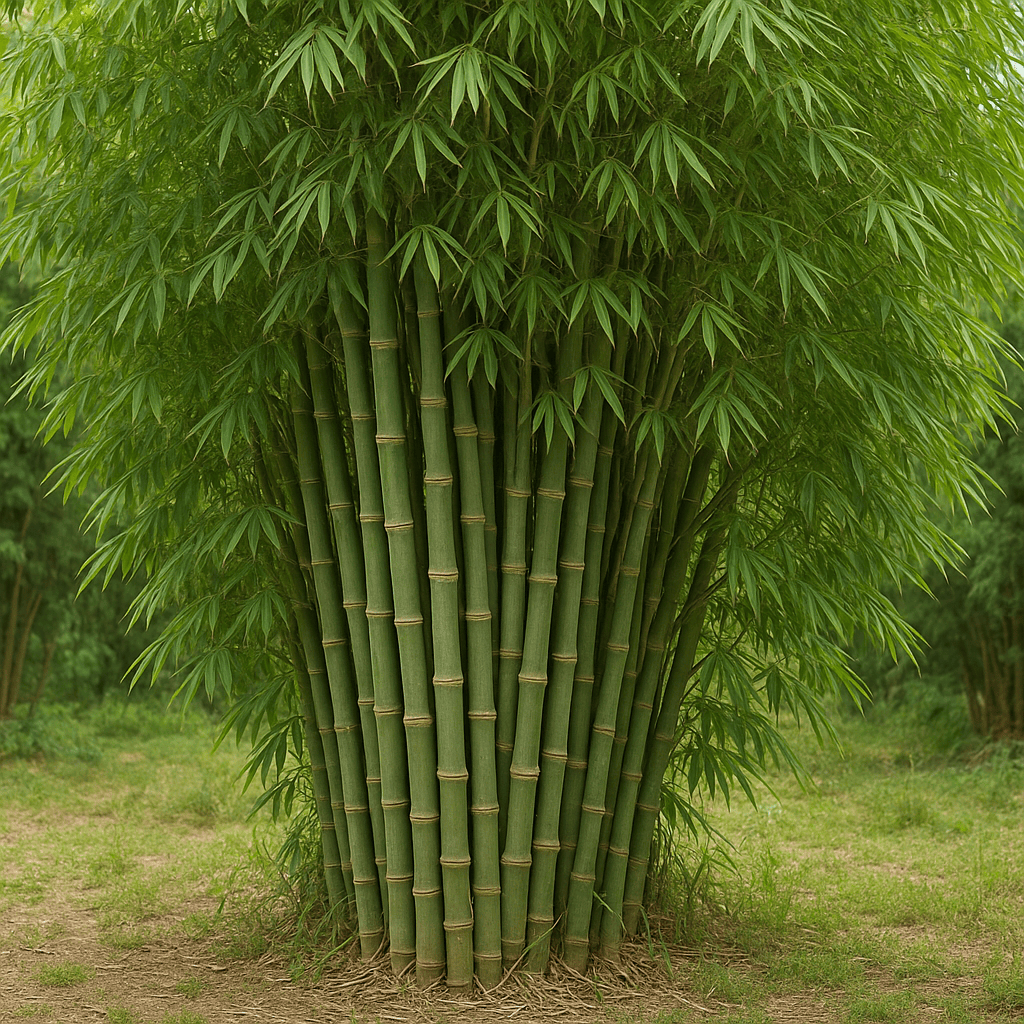
It is a tall, dull long green-colored bamboo species that grows in thickets consisting of many heavily branched, closely growing culms. It reaches a height of 6–18 m. Culms are green and covered with white blooms, which become dull green when mature and turn brown on drying. Young shoots are brown in color and covered with white blooms. Culms are straight. Branching occurs from the base to mid-culm. Aerial roots reach up to a few nodes above the ground. Internode length is 20–30 cm, and diameter is 2.5–12 cm. Culm walls are very thick. Nodes are not prominent. Culm sheaths are green in young, and turn brown when mature, and are cylindrical. The sheath proper is 18–22 cm in length and 10–17 cm wide. Blade length is 3.5–6.5 cm. Auricles are absent. The upper surfaces of the sheath may or may not be covered with brown hairs. The lower surfaces of the sheath are not hairy. Sheaths fall early. They are used for making house frames, rafters, tent poles, concrete reinforcement, walls, scaffolding, and fences. The leaves are used for thatching. Used by the British army in India for making lance shafts.
Dendrocalamus strictus is a perennial, clump-forming, evergreen bamboo producing woody culms that are often much-curved, 6 – 20 metres tall. The thick-walled culms are 25 – 75mm in diameter with internodes 30 – 45cm long. Although usually evergreen, plants can lose their leaves in extended dry periods.The plant is commonly harvested from the wild for food and for its stems, which are used locally and also traded. This species is one of the two most important bamboos in India. The plant is sometimes cultivated, especially in tropical Asia, for its stems.
The stems are used for a wide range of purposes – scaffolding, bridges, poles, agricultural implements and other large bamboo implements. They are also split and used to make other items such as walking sticks, furniture and baskets.
The stems are extensively used as a raw material in paper mills.
Harvesting may start 3 – 4 years after a clump has begun to produce culms of maximum size. Only culms older than 3 years are harvestable and harvesting should never be done during the growing season. It is recommended to cut the culms lower than 30cm above the ground level, but not below the 2nd node. Debris and cut branches should always be removed completely.

Leave a Reply